
Fox in Socks
Dr. Seuss (1904–1991)
HarperCollins • 1992 • 61 pages

About the Author
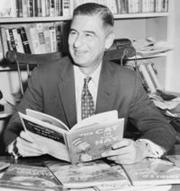
Dr. Seuss
1904-1991 · 3 works
Theodor Seuss Geisel was born on in Springfield, Massachusetts to German-American parents. He attended public schools and then went to Dartmouth College, where he became editor of the Dartmouth _Jack-O-Lantern_. When he was barred from all extracurricular activities, he continued to write for the paper using the pseudonym "Seuss." After he graduated he became a contributor to the magazine The Judge, and began to sign his work as "Dr. Seuss." He attended Lincoln College, Oxford to earn a D.Phil in literature, but married Helen Palmer in 1927 and returned to the United States without earning the degree. He published humorous articles and illustrations in _The Judge_, _The Saturday Evening Post_, _Life_, _Vanity Fair_, and _Liberty_ and supported himself and his wife through the Great Depression with commercial illustrations for General Electric, NBC, Standard Oil, and many other companies. He also wrote and drew a short-lived comic strip called _Hejji_ in 1935. In 1937, returning from an ocean voyage to Europe, he wrote his first book, _And to Think That I Saw It on Mulberry Street_. When World War II began, he began to create political cartoons and became an editorial cartoonist for the left-wing New York City newspaper, _PM_. His political cartoons were later published in _Dr. Seuss Goes to War_. In 1942, he began producing propaganda posters for the Treasury Department and the War Production Board. In 1943, he joined the Animation Department of the First Motion Picture Unit of the U.S. Army Air Forces, where he wrote propaganda and training films. After the war, he and his wife moved to La Jolla, California. He returning to writing and illustrating children's books. In 1954, _Life_ magazine published an article on the dullness of children's books, and Geisel was inspired to write _The Cat in the Hat_. In 1967, his wife Helen committed suicide. He married Audrey Stone Dimond in 1968. Geisel died in La Jolla, California in 1991. Over the course of his career, Geisel wrote over 60 children's books, either under the pseudonym "Dr. Seuss" for the ones he wrote and illustrated himself, "Theo. LeSieg" for books he wrote but others illustrated, or "Rosetta Stone" for _Because a Little Bug Went Ka-choo_ (1975). He also wrote two books for adults: _The Seven Lady Godivas_; _Oh, The Places You'll Go!_; and _You're Only Old Once_.
Description
The book begins by introducing Fox and Knox (sometimes called "Mr. Fox" and "Mr. Knox") along with some props (a box and a pair of socks). After taking those four rhyming items through several permutations, more items are added (chicks, bricks, blocks, clocks), and so on. As the book progresses the Fox describes each situation with rhymes that progress in complexity, with Knox periodically...
The book begins by introducing Fox and Knox (sometimes called "Mr. Fox" and "Mr. Knox") along with some props (a box and a pair of socks). After taking those four rhyming items through several permutations, more items are added (chicks, bricks, blocks, clocks), and so on. As the book progresses the Fox describes each situation with rhymes that progress in complexity, with Knox periodically complaining of the difficulty of the tongue-twisters. Finally, after the Fox gives an extended dissertation on Tweetle Beetles who fight (battle) with paddles while standing in a puddle inside a bottle (a Tweetle Beetle Bottle Puddle Paddle Battle Muddle), Knox acts on his frustration by stuffing Fox into the bottle, reciting a tongue-twister of his own: When a fox is in the bottle where the tweetle beetles battle with their paddles in a puddle on a noodle-eating poodle, THIS is what they call... a tweetle beetle noodle poodle bottled paddled muddled duddled fuddled wuddled fox in socks, sir! Knox then declares that the game is finished, thanking the Fox for the fun, and walks away while the beetles, a poodle, and the stunned Fox watch. - Wikipedia.
This Edition
HarperCollins · 1992 · 61 pages
- ISBN-10
- 0001717987
- Language
- ENG


